
We all know the feeling of someone talking down at you about a film, music, whatever — they have a certain look in their eye as they barely contain the orgasmic rush of correcting whatever perfectly legitimate opinion you dared to voice in the same smoking area as them. Anything from ‘I didn’t really get it to be honest’ or ‘it’s no Monsters Inc.’
One of the best films of all time. Fight me.
It’s especially the case with the abstract. The sheer volume of people I’ve met who are put off — not by extravagance or style — but because they claim not to ‘get it’. That’s fine. That’s completely fine to say — but what you often find is that someone has told them they don’t get it. It is endlessly frustrating to see people put off whole sub-genres because of elitist pricks.
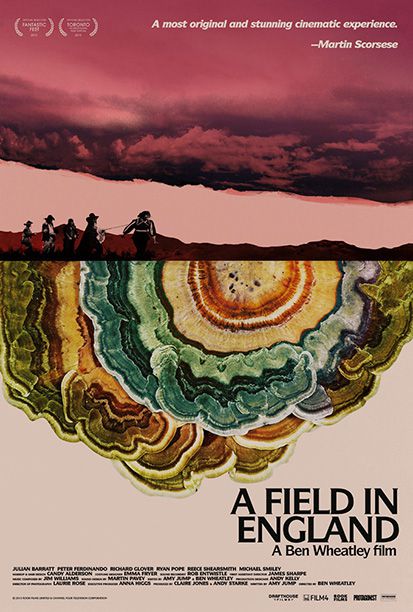
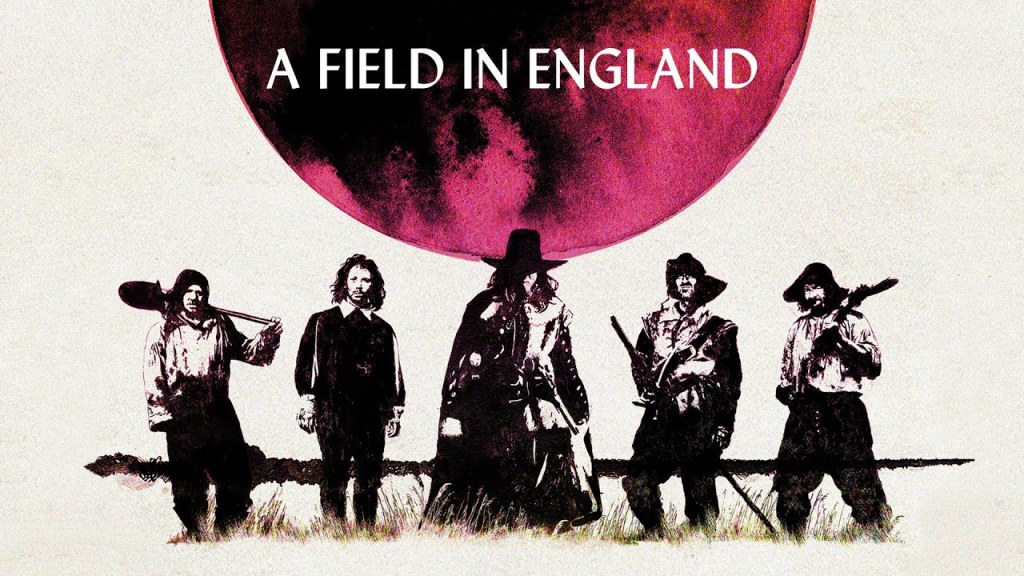
There is a film however that inspired me, back in 2019, to stop worrying about how smart I sound, and to enjoy what’s put in front of me. The 2013 film ‘A Field In England’. Directed by Ben Wheatley (‘Kill List’ 2011, ‘Sightseers’ 2012) and written by Amy Jump is a film some of you might know. It has the familiar faces of Reece Shearsmith and Michael Smiley, but a distinctly unfamiliar and fresh addition to a rich catalogue of UK Folk horror. Let me me tell you why it changed things for me.
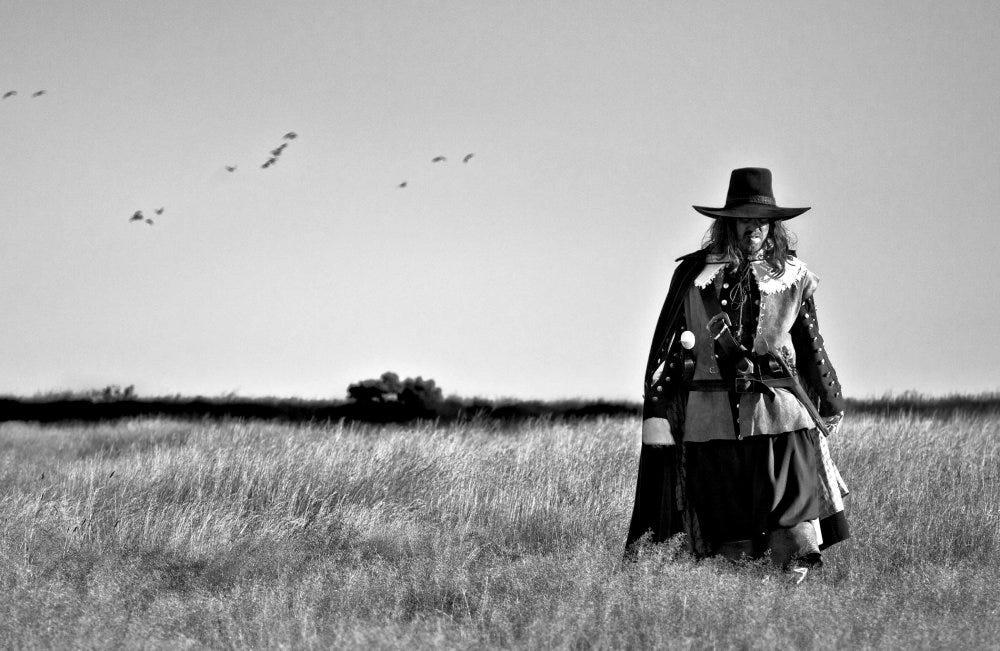
I can’t remember the last time I was so struck by the style of a film, rather than plot and art design. It’s a film that’s nostalgic of the 20th century hallucinogenic movies — surreal works like ‘Holy Mountain’ (Alejandro Jodorowsky, 1973) or ‘The Devils’ (Ken Russel, 1971.) It’s a style that runs deeper than any surface level darkened texture and literal monotone colouring — it’s a style of anti-exposition. It’s a film that doesn’t like explanations, and as you can imagine I spent a while furiously trying to work out what the ‘meaning’ of it all was.
Let’s not do that. It’s not productive for me, and it isn’t what I love about this film. What I loved was the experience of it.
The film revolves around a band of men including an alchemist (Reece Shearsmith) who find themselves fleeing from an English civil war battle — accidentally stumbling upon a field filled with mystical mushrooms and a sorcerer (Michael Smiley) who promises there lies a great treasure underground. It doesn’t take very long to realise this film is ‘style’ rather than… well, rather than what? That’s the question here isn’t it? How do you talk about this without feeling like a prick?
It’s a work that doesn’t feel the need to explain itself in any respect. Wheatley even commented in an interview with Film 4 that he didn’t want the characters to be constantly explaining an environment which they’re used to for an audience. Maybe the best way to think about this film is not so much as style over substance, but style under substance – supporting, propping it up.
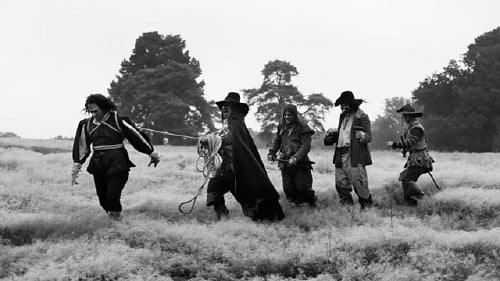
It does all seem quite realistic with these characters – whose personalities are so diuretically opposed that it feels like a lost Friends episode or Spice Girls interview – until of course you reach that stunningly twisted mid-point. long story very short – the characters all find themselves lost in a shroom-fuelled trance of fear of mystic obsession as they attempt to escape the sorcerer and the imposing physical boundary for them. It’s fair to say the cinematography goes absolutely off the rails.
Oooh look at me using ‘cinematography’ for an art house film. Yes I know sorry.
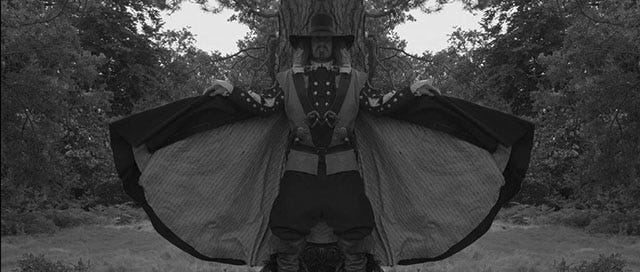
We see the whole world of the film through a lens of ceaseless strobe lighting and frantic manipulated angles to give everything a overwhelming otherworldly quality. The work throws aside any coherent plot to instead provide you with a singular, terrifying experience, ignoring familiar structure in how we understand events to follow on from each other. You almost get the sense that it’s all happening at the same time. I lost track of time and just sat there actually watching the film. As someone with such a short attention span, properly losing track of time with a film is rare.
A Field in England isn’t about standard logic, cause and effect — but a mythos deep in the mud — forgotten and only surviving in images, whispers and shadows. It comes from an abstract layer that is not processed through the routes of the brain we’re used to listening to. It’s immediate and visceral.
It’s like an upheaval of the sub-conscious, and yet it feels distinctly human. The characters develop their own individual sense of fear, Shearsmith’s character transcending to an almost prophet like state of madness while Richard Glover’s character becomes obsessed with a religious fervour, constantly trying to work out why God is punishing them and ultimately facing the potential absence of any divinity. So you still get a sense of who everyone is, the problem is only the ‘why’ bit — that’s not so clear cut.
The images we’re provided come in a succession of acts, sometimes even introduced by the characters posing in Brecht-like stills to remind us all that what we’re watching is unique from what we were expecting when we first sat down. The scene with Shearsmith consuming the circle of mushrooms feels climactic, as does the sequence where the sorcerer’s image on screen is physically manipulated time and time again into mesmeric, almost mandala-esque patterns — so you end up with what appears to be a bat like figure looming out of the screen. The soundtrack by Jim Williams often blends folk-like traditional music of the period (with Richard Glover having his own ballad part) and sweeping modern ambience — again creating this uneasy feeling as you’re unable to place the film in any kind of genre.
The scene I felt this sense of ‘active feeling’ (I don’t know what to call it leave me alone) is that one section where Shearsmith is possessed. After what feels like an eternity of listening to him screaming we see a slow motion procession of him grinning madly, tied up with a rope harness and lead out by the sorcerer — wielding him like a pet as he runs to the sound of a flute playing ‘ring-a-ring-a-roses’.
The whole thing sounds ridiculous but when you see it it strikes an uncanny nerve and the piece seamlessly transitions into that of a bizarre horror without you really noticing. It’s the kind of disturbing you can only get from an image or a slight glance of the eye, a discomfort that’s ramped up by something so small. All these images thrown at you one at a time feel like a surreal avalanche, but one that seems to have some kind of purpose. Even something simple like a man lying in a field which is upside down — you’re constantly having your expectations subverted again and again. Sure, the more the film does this the less effective it gets, as you eventually learn to not expect anything at all. Perhaps it does rely on this one technique too much, but it still works like a treat for me.
Experiencing abstract work can be immediate or gradual, but it should come from a place that you can’t really explain. That’s how I felt about this film. I have my own opinions on what all this symbolism could represent, but that’s irrelevant. It would defeat the point for me to drag you through it. For me the film is about making you think about that unseen place, what the boundaries of it are, and how fragile our understanding is of things we don’t talk about – the world around us, the history under our feet.
Don’t worry about explanations, or hidden meanings or ‘getting it’. I have no idea what ‘A Field In England’ is about, all I know is that it left me with an overactive brain.
Watch it, see what you think. Either way, don’t ever say you don’t ‘get’ something. You’re clever and intuitive, and your opinion counts for as much as anyone else’s. Have a little feel every now and again.


 stghostycreative.co.uk
Leave a comment