
Things are happening! Right here. Right now. But where is here and what is now? Well it’s the end of 2025. We’re all exhausted and keeping your head up is hard. More specifically to us, being an artist, making money to sustain a career, seems as impossible now as it has ever done. If anything it’s worse.
You want to be an artist? Then you should also be ready to be your own administrator. Your own producer, probably your own director for a while. You’ll have to proof read and edit everything. Oh – and you’ll also be head of sales, cold approaching organisations to convince them to pay you attention. You’ll be a video editor, head of photography and fundraiser. Oh and don’t forget you’ll also be the head of social media content and marketing because, of course, you should probably make some reels about something.
But we’re seeing something interesting. Some people (and I only mean some) are actually giving money to artists to make art.
You heard me.
What’s the Deal?
Subsidising art is the process of using public or private money (more often public) and using it to provide funding for artists and artistic projects. This means organisations or administrations putting up state or commercial funds to pay artists where funding or restricted spending doesn’t. It was much more common in creative organisations in the 50s and 60s, where creativity was majority private sector and had cash to spend on the privileged few. Residencies at creative companies across 5 central practices are estimated to have been at a 40% higher rate , as much as you can compare the two rates in staggeringly different economic climates.
Likewise, easing of pressures on things like rentals, food and provisions for individuals working towards the arts was that much more precise. And the results were therefore more profound. We have more early-mid scale creative companies and individuals, but much less money behind it – mainly because of the razor edge of post-austerity, Brexit and Covid UK policies. That’s without even going into the practical overheads of touring and festival work, whose basic necessities from scaffolding to public liability insurance has ballooned.
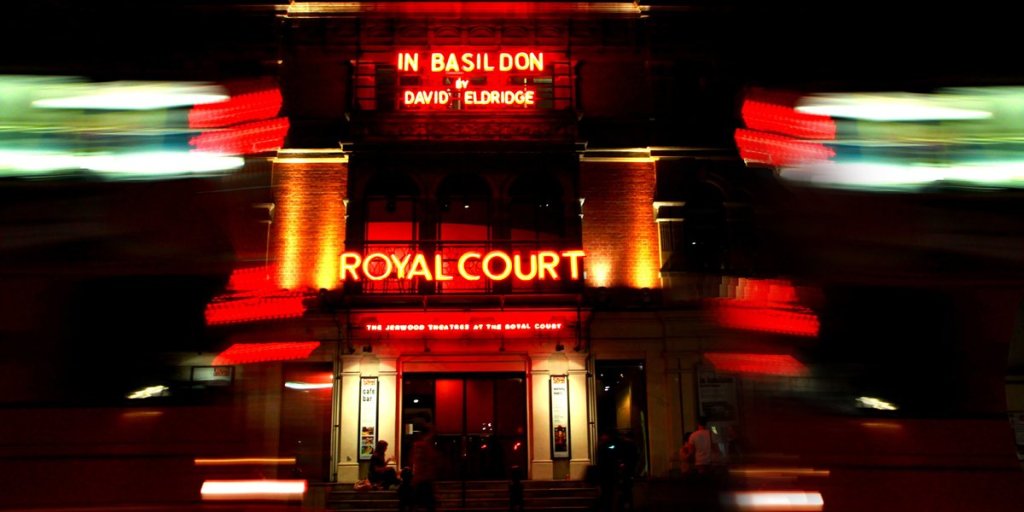
But there’s other bits of news which catch your eye. The Royal Court Theatre, Funded by Jerwood, have recently announced their seed commissioning scheme. In this scheme, emerging artists can apply alongside a partner organisation to develop a show concept. The idea is that the Court will award this to 6 partnerships and then offer the money for the producing company to pay the artists for a seed commission i.e. to create a developed script or an idea. The Court essentially act as a front-end facilitator for the producing company, but simultaneously as a supporting funder for the artist. Rather than having a single company as an investor.
The producing company still has to front part of the commissioning costs further down the line, but it takes the pressure off that first bit of the process. It gives community based groups and grass roots organisations that chance to formalise their processes (creative and business-wise) with actual money behind it. If we exist at a point where there is now a 30% drop in new plays being produced in the UK, and other creative industries following similar risk-averse policies, how else do we expect to thrive?
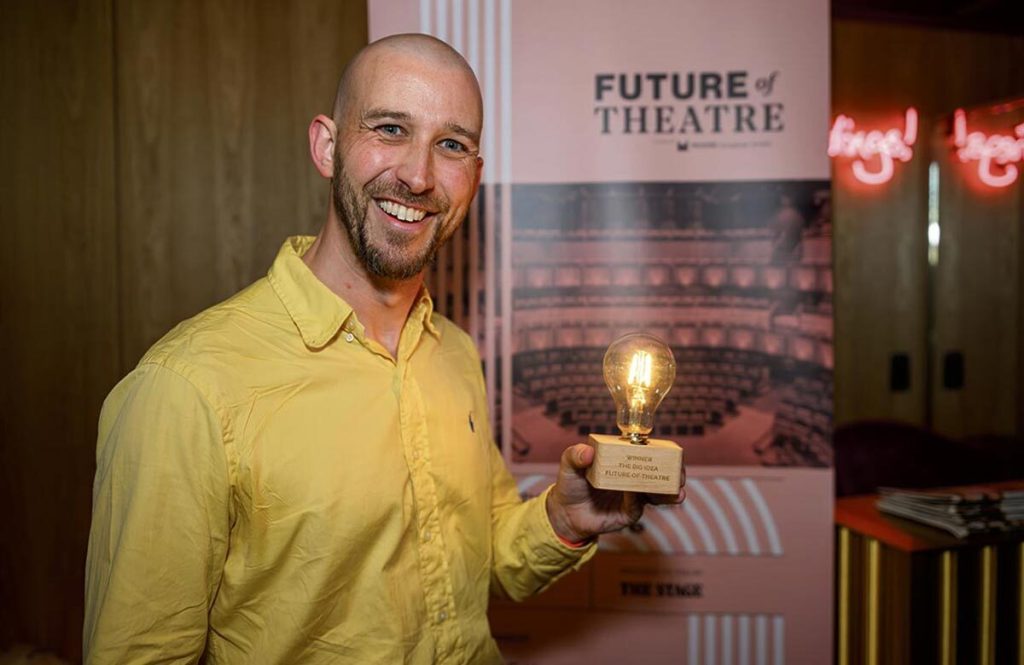
We’ve only just been speaking about the threat that funding cuts, both in private and public administration worldwide, poses a threat to creativity (see whole article here.) But schemes like this seem to give a little hope. It echoes the ideas put forward by the likes of Rob Myles (see left) at The Stage’s Future of Theatre conference last year, where he put forward a subsidised national touring network to help support local touring routes, financially backing companies, and decentralising theatre through a pooling of resources (including the National Portfolio funds of the likes of National Theatre and RSC.)
Similarly, Lara Zankoul has been vocal in challenging the extent to which BFI funding programmes actually support the ability of new filmmakers to leapfrog the initial cost of filmmaking – an industry which relies on mutual connections. Even Arts Council England, following a review of DCMS (Department of Culture, Media and Sport) spending policy between arts and education developed an incentivised touring scheme which, while still under development in a largely practical sense, aims to achieve similar points of decentralising art and creativity.
But let’s take, quite possibly, the biggest example of this in recent news. The Basic Income for Artists scheme in Ireland, which is now officially being made permanent – with applications for the full scheme opening up in September 2026.

BIA – why is it so vital?
The Basic Income for the Arts scheme feels revolutionary. It puts forward the concept that allowing payments for artists to support them during periods of low financial income in order to promote them focusing on developing their artistic practise may actually lead to those artists developing a paid career in the arts. So, does it actually work?
The wealth gap in art is already evident, with the average household income of families raising children in artistic jobs earning above 70% of the rest of the population over the course of 30 years. People who can be financially supported are estimated to be up to 45% more likely to develop a career in the arts than someone coming from a household either with a low combined/single income.
BIA follows a successful pilot set up in 2022 to help Ireland’s arts and culture sector to recover from Covid-19 pandemic – a trial which is interestingly followed by a landmark recent report published by Arts Professional showing that the scars of COVID on Arts and Heritage are much more complex than first thought (see more here). An evident ‘miss’ of most funded reporting is the lack of discussion on what community arts groups across the UK have made clear for the last 25 years – that these aren’t just recent disturbances in the sector – but rather are pre-existing gaps which have been worsened by numerous economic shifts. As much as we dress it up, we are after all in a business. And one whose commercial priorities in terms of ‘who’ it serves have been clear for a very long time.
So what does BIA show? What does happen when we essentially subsidise new artists? Well, within the first year, a trial group of artists were on average 9% more likely to be able to sustain a career in the arts, which when you take out of a national population of roughly 5.4 million, equates to (in broad strokes) 90,000 more artists being able to sustain a career in Ireland.
The Basic Income for the Arts pilot provides 2,000 artists and creative arts workers with €325 a week – equivalent to about £285. It was due to come to an end in February 2026, however it has now officially been made permanent. At least 2,000 places are expected to be made available, with applications set to open in September 2026.

These figures aren’t just pulled from nowhere. While all data should always be questioned and correlations tested, the BIA had, within it’s funding, money for it’s results to be as rigorously assessed as any piece of research – in frameworks which far outstripped the majority of most government backed evaluative work. According to the research, 31% of BIA recipients reported an increased ability to sustain themselves through arts work alone, and the number of people who reported low pay as a career barrier went down from one third to 17%. Individuals within the trial were found to be 14 percentage points more likely to have completed new works in the previous six months than the control group. This after just six months. SIX.
A common criticism of public subsidy is usually that we are somehow ‘funding’ artists from our own pocket as working people i.e. so sorry, Tiny Tim can’t have a turkey this year because Dave from Birmingham is making an experimental piece of physical theatre.
It doesn’t take a genius to realise that isn’t how this works. Public money is an asset used by all government departments. Rather than seeing it as a tax on your wages that goes into public services, subsidy from public money is actually much wider than that and being regularly distributed to causes that I’m pretty sure Tiny Tim wouldn’t approve of.
It’s not breaking news that money invested by banks on your behalf from what should be your pension, more often go into dividends and asset portfolios aka. private profit. However, artists on a BIA were actually found to invest more money in their careers and local services, spending €250 a month more on equipment, transport and other expenses than the control group. When you consider the rural or small town setup of many of these artists’ residences, it doesn’t seem to far of a stretch to assume that much of that money went into independent, local businesses. Even putting free market preferences aside, I would love to challenge anyone to convince me that the board of directors of Thames water deserve their dividends over 90,000 potential new artists creating work that stimulates activity and returns on everyday investments through tickets, bars, public travel and restaurants.
After all, I’m quite curious to see Dave’s new physical theatre piece now.
The question isn’t about how much money we want spent from our pockets, but rather becomes about where do we want our money? Public or private benefit? Close or far beyond our reach?
A Healthy Perspective

There were also noted positive factors in wellbeing. BIA recipients were 15 percentage points less likely to have felt depressed or ‘negative’ emotions, and 16 percentage points less likely to have experienced anxiety. Simultaneously, 17% of BIA recipients reported high life satisfaction compared to only 5% of the control group. BIA recipients also spent almost 1 weekly hour more on leisure activities, 30 minutes more exercising, and 20 minutes more volunteering than the control group.
The effects are evident, and while I don’t want to list them all, I have copied the top line results from the report itself for you to see below. I want you to remember that this is within the first six months of the project. You can see the full summary of the reports here.
- Each week, BIA recipients spend one and a half hours more on research and
experimentation, one hour more on management and administration, and one
hour more presenting to audiences compared to the control group, i.e. 3.5
additional hours on their creative practice per week. Within the first year this went up to 8 weeks more. - BIA recipients are 12 percentage points more likely than the control group to be
able to sustain themselves through arts work alone. - Life satisfaction, measured on a scale of one to ten, increased by more than half a
point for BIA recipients compared to the control group. - Depression and anxiety experienced in the previous 4 weeks decreased by almost
10 percentage points for BIA recipients compared to the control group. - BIA recipients were 19.2 percentage points less likely to have difficulty making ends
meet compared to the control group.
BIA, more than anything, shows that subsidised art works. And this isn’t the first time – in the UK particularly during the 1980s, public benefits for unemployed individuals were much more generous with the time of an applicant, allowing countless musicians, comedians and actors that we know today to develop their career within a matter of years. BIA has potential, and it’s here to stay. Does it solve all of our issues? Of course not. But it makes you wonder what the rest of us can learn from this. The resources exist – the question , as ever, is where are they being put? and ‘who for?
The Future
There is a basic bottom line that is constantly left out of conversations like this. The likes of these schemes and ideas, BIA, Subsidised touring, equipment rentals through community collectives, community art committees – they all have potential. But so often, they’re shot down before even having a chance to walk – not out of any rigorous analysis, but out of a knee jerk reaction of ‘it’s just not practical’.
I can’t run from the fact that I work in the arts, of course I’m invested in this. But it has the potential to benefit so many. Imagine the scale at which this could be rolled out if successful, imagine the commercial benefit to local businesses, imagine the cultural explosion it could create.
This isn’t a pipe dream, this isn’t woke and it’s not temporary. These ideas are gaining traction that was set in motion more than 100 years ago – and while they’re not perfect, it’s up to us to advocate for them.
You’re not a waste of a time and neither is your craft, you’re not stealing Tiny Tim’s Turkey, you’re not draining the NHS or wasting universal credit systems. You’re not embarrassing yourself. Take the space, take the initiative and take the chance.
Most importantly, make them pay you for it.
Got something to say?
Then share it with us! Our Mic’d Up submissions are open. We want to hear your reviews, essays and opinions in all their forms. See our Opportunities Page for more details, and email us at stghostycreatives@gmail.co.uk to submit or ask for more info. If you like talking about arty stuff as much as we do, then we’d love to hear from you!


 stghostycreative.co.uk
Leave a comment