

Don’t you love it when you have a great idea? Half the time they’re probably not even that great, but it’s the smug self-satisfaction that just helps get you through the week knowing that you, in all your glory, had a great idea.
I realise that by starting with this I’m building myself up and no, I haven’t in fact had a great idea. Someone else did a while ago, and it’s one we’ve always found super useful.

Feedback is always a deeply personal thing, almost as much as how the person themselves writes. Every practise will have industry-specific methods for delivering criticism, while script editors for a TV series will give notes one way, a game design studio will give them another – focusing specifically on how/ what the writing is supporting a project.
I’ve always maintained that editing is where a piece of writing finds traction. The revision process is where the real themes come out, as well as the means by which these themes can speak. The details are invaluable and more often than not, they’re what elevate something from one level to another, the things that qualify a piece of writing as, what I heard one editor describe as, ‘serviceable’. Therefore, it seems natural that the methods by which I receive criticism are very important to me.
Inner Critics, Outer Voices
Criticism, especially at these early stages has to be brutal, honest and it has to seem more like someone is trying to stop you writing this thing. Whatever they’re saying is a test, and you thinking about it is the solidifying agent to your work. There is no better way to think more honestly about your creative practise than by having to justify it. Likewise, there’s no better way to realise something about your writing that isn’t working, than scrambling to defend it when deep down you know it’s not working. Of course, it’s all about opinion and perspective but sometimes you’re lucky enough to get feedback from someone you really respect, or at least you respect their knowledge/ experience. Same thing really. As much as that can make us nervous.
This happened to me recently. I managed to get feedback from someone working in the UK theatre industry, someone who has done so for nearly 20 years and has worked at a theatre I especially admire. Personal feelings aside, this individual has a track record of reading and editing scripts at all levels of production, from high end commercial heavy-hitters to mid-touring shows, to riskier, experimental ventures. So when I was offered feedback on a recent full length script I had written, I naturally bit his hand off. So I popped it off to him and waited about two weeks.
Promptly, as I thought he would, he returned the script to me with just the right amount of detail. I hadn’t paid any kind of fee for this service due to not being a literal millionaire, so I wasn’t necessarily expecting much, just hoping for it. Lo and behold he came back with detail, thought and questions that made me go over the whole script in a different light. He spent time praising some parts that he liked but the majority of the feedback was focused on questions, criticisms and all the moments that let it down. These were numerous, and I’ll be honest I initially felt disheartened.
That is until I realised that the point of this was to be more professional about how I look at my writing. The point of this was to give snappy, direct criticism of the play and its ideas/themes. It was at a draft stage but that’s no reason to go easy on something. What I had been given was a thematic price tag for how to pass the script over into new territory outside the ‘draft’ space.
This can be hard to do, especially if you’re really keen on the idea, it can feel impossible to move out of a certain frame of mind but this helped me to push it along. There were even a few points that I outright disagreed with and ignored, but their existence made me justify myself, and took me through the process of having to formulate those ideas in my head. Each formulation was a new layer, a new coat of paint on an idea that had started as a vague thought following nothing more than a dream. He had given me, in a weird way, my ideal feedback.
Short. Snappy.
It’s with this that all of us here have fallen into the habit of passing every new work we try to make through a SNAP. Because if you’re going to be torn apart, it should at least be useful for something.
- A SNAP is feedback in it’s most essential way. The first jaws that tear at your precious creativity. A harsh, quick attack that’s there to see what your writing is made of. Over time, I’m finding it more and more useful. After all, it’s purpose, ultimately, is to make you better at your craft.
- A SNAP is feedback from someone you trust. Not just someone you like or know well, but someone who will tell it straight, regardless of your feelings. This is feedback that is designed to test you, and while it’s not deliberately hurtful or ignorant, it’s purpose is to attempt to deconstruct an idea you’ve laid out.
- A SNAP is brief but definite. You want details, key ideas and points but you also want them in a list. This is a key part of the feedback. It should demonstrate the critic has read and considered the writing extensively, but it should also allow the writer a ‘list’ of issues to work through. It might seem counter intuitive to lay out problems like this, and it’s definitely not a ‘do-all-these-and-your-writing-is-good’ list but the compact nature of the feedback is also what makes it feel ‘do-able’ for the writer, rather than just overly daunting. In reality, each point will probably lead to a hundred others, but this setting makes the initial conception of revision that much easier to work through.
- A SNAP can include positive things too. It shouldn’t be deliberately brutal for the sake of it and so can include things that the critic particularly enjoyed about the piece HOWEVER, these should still be constructive. If you’re giving criticism, then you’re mentioning the positives because you want the writer to remember these. In the depths of the editing process, it can be easy for a writer to become overly-critical out of some sense of cynicism. Constructive praise is useful to give a writer an anchor to hold on to in terms of what you like about their idea. I could even imagine a SNAP where, if there weren’t many criticisms to give, it would focus more on encouraging the writer to focus on different key points that are being done equally well.
- A SNAP is a test. If you receive strong criticism that basically turns away your idea entirely, then don’t be too disappointed. It may be that your idea still has legs, but like any other criticism, it’s just that person’s opinion. Equally, maybe consider dedicating time to new ideas if this becomes a theme among multiple people you trust.
- Perhaps most importantly, get multiple SNAPS if you can. Due to their nature, it can be that you need quite a good relationship/ understanding with the person giving criticism but try getting more than one. You might find them picking up different aspects of the creative process, which might help you develop more of an aggregated or even approach to editing the piece.

Basically your process is your own. What is most important is to do what works for you, and to try as much as you can to broaden this process as you work through the development of your own ideas. SNAP is just one I’d recommend trying if you ever get the chance.
It’s harsh nature is actually what makes it liberating, and it’s a pretty good feeling when you’re left with this list of easily digestible criticism to work through. Not only that, but historically, I’ve come up with my best ideas while trying to justify/fix something else. See how you go, it might work for you, it might not.
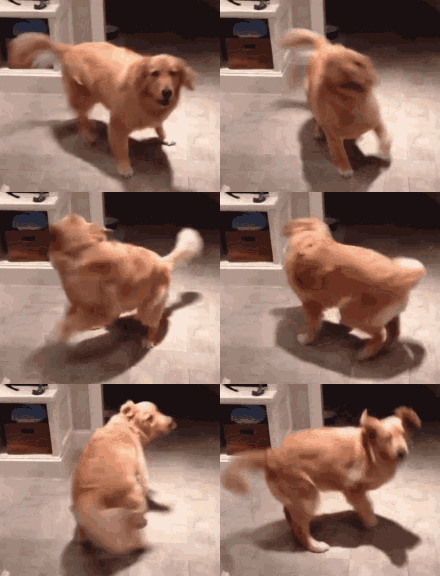
I’ll level with you. This was also an excuse to share lots of images of dogs. Sorry.


 stghostycreative.co.uk
Leave a comment