

We love questions. The act of questioning is both an act of uncertainty, and a declaration of intent. The more metaphorical, the more unnerving, the ‘bigger’ the question, the more we desperately demand an answer to it. But then the emptiness at the heart of these ‘bigger’ questions is what terrifies us the most, what most definitively shakes our our ability to experience aka. It freaks us out.
A question can tell you more about the speaker, than the place from which the answer is demanded. Questioning becomes simulative, a reflection of what we desire the answer to be.
There’s a point to this I promise.
‘Songs from the Second Floor’ (2000) is a Swedish black-comedy film directed by Roy Andersson that forms the first of the ‘Living’ trilogy of films, the others being ‘You, The Living’ (2007) and ‘A Pigeon Sat on a Branch Reflecting on Existence’ (2014). I watched it recently and had to take a ‘break’ from doing ordinary things to stare out the window and re-evaluate my life — in a good way I promise.
While Andersson is the recipient of international critical appraise for the overall anthology of his work, it seems to me that his narrative drive, his motives and his emotive style is most evident in the first of this trilogy. A film that asks a most fundamental and unnerving question. Where is the human race going?
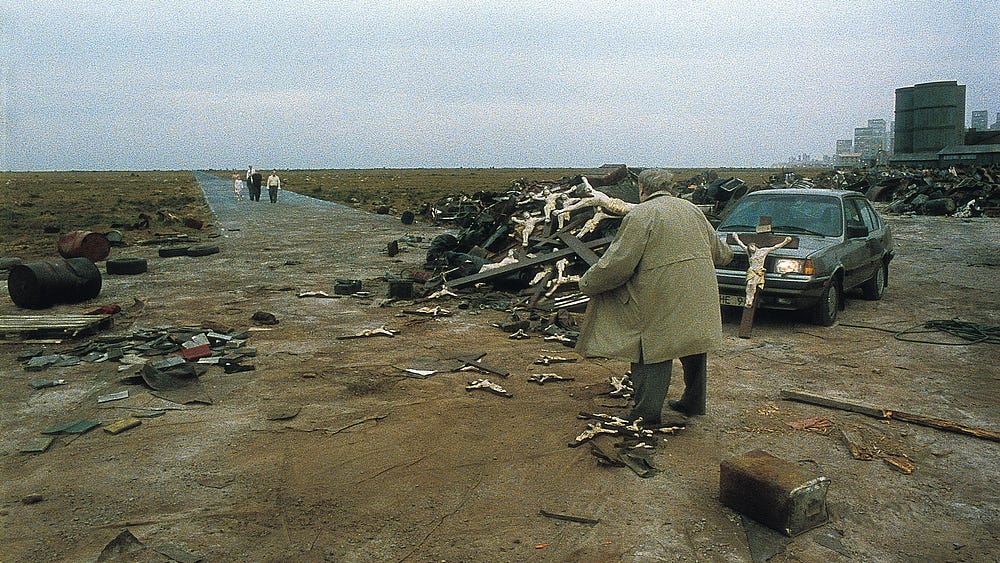
The film is a series of loosely connected events, seemingly unrelated happenings connected by a keen sense of place and time. We see a businessman shuffling through this bleak, blank city as his business burns down and his son is incarcerated in an asylum for ‘reading too much poetry’. We see a magician whose magic trick goes horribly wrong, a general late for a funeral, a man and wife who no longer speak, a clerk being thrown out of his job after 30 years — the list goes on. These individual events connect seamlessly to form the greater ‘character’, the dramatic sense of experience fills in any gaps we feel we’re missing in terms of the individual people before us. While in any other setting this might seem lazy, in the sub-genre it becomes an essential part of the narrative.
It’s a technique I admire, and often try to emulate. The act of overloading the viewing with information so that, what they extract, seems all the more vital or insightful. Alan Moore is a famous example of the power of ‘dramatic sense’, the concept of experience being delivered through multiple, interweaving storylines that only ever give you a glimpse into several un-tampered boxes of lived presence. I think we all know someone who’s read ‘Watchmen’ and recounted what an ‘important’ book it is, though never really being able to offer a fuller explanation than “y’know like, the 20th century and stuff.”
Another favourite example of mine is ‘Scenes from The Big Picture’ (2003) by Owen McCafferty, which takes a look at more than 20 characters going through their daily lives in Belfast, undergoing the small movements in constancy to weave a far more expansive impression, a ‘bigger’ question. The sense of experience builds a narrative idea of where we want to go as spectators, and where we want to be is something Andersson is particularly interested in.
The effort here is not to deliver some grand set of tales but rather a sense of experience in one, monist, singular arc, that in its own way is has an epic poetic form. In fact it’s something I talk more about in one of my other articles on the work of legendary abstract filmmaker Stan Brakhage.
The lyrical aspects of the way everyday events are interwoven forms its own, all-encompassing narrative illustrated by abstract, bizarre set pieces that, rather than existing as beats of a script for provocation, are instead the natural, symbolist conclusions to the film’s essential question.
Notable scenes include the aforementioned businessman returning home from his business being burnt down on the subway, when suddenly a chorus of commuters begin singing opera on the way home. Likewise, we see a horde of people all carrying huge cases on trolleys incredibly slowly, hauling their luggage into an airport, desperate to escape, desperate to feel like moving while crying out to be ‘free men’. Andersson takes the infinite complexity of small moments of characterisation and takes them to their most logical conclusion, the unreal. He takes the symbolist approach in style, to signify through representation and viscerally, texture underpinned by coherent, fluid thought rather egoistic rationalism.
So, where does Roy Andersson think we’re going?
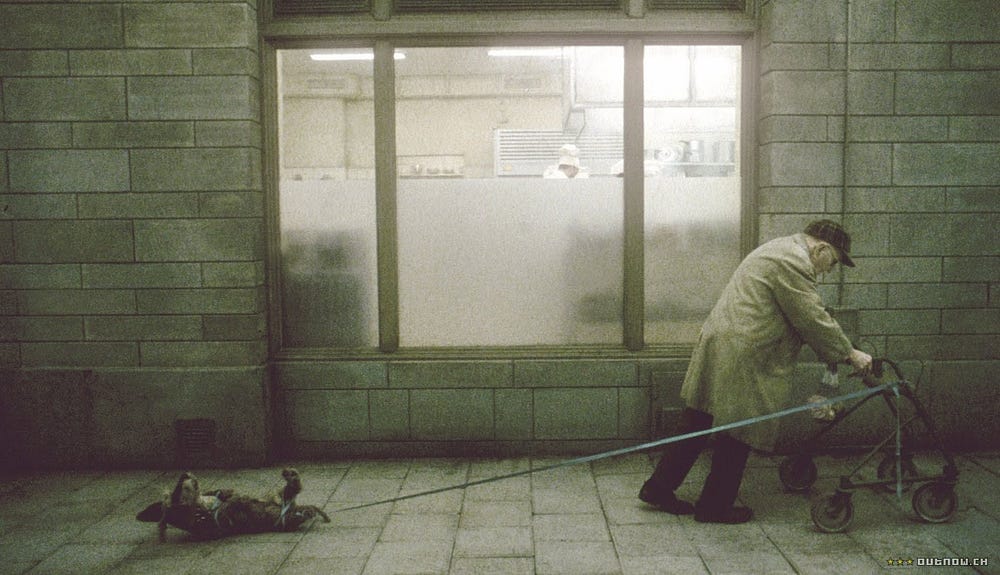
Rather than doggedly sticking to symbolist mantra, he abandons their greatest flaw, the idea of expressing basic truth. Andersson seeks to express the basic in a poetic and lyrical sense, but at no point offers the clarity of nominalist objectivity. The uncertainty of the narrative is what makes this unusual film a comedy of sorts. Every situation seems to have a simple or anti-climactic solution that injects humour into the situation. The ending in particular, sees two businessmen throwing crucifixes onto a land waste site, as if the whole thing was just some odd venture that fades into memory.
There’s not just a lack of truth but an assertion that truth is not possible, only details we use to assert familiarity.
The film is based on the poetry of Peruvian poet César Vallejo, particularly his poem ‘Beloved be the one who sits down’. The film is structured entirely around his words, his images and his divine sense of both hope and hopelessness. In an effort to not just emulate Vallejo’s aesthetic, but to exist in the ideas presented by his poetry, Andersson places us firmly in the role of spectator, as we watch a series of familiar, misguided human being sleepwalk to their own decay.
A key strategy with this narrative ‘overload’ technique is to have central symbolic motifs that link the vignettes in synchronised motion. Andersson presents us with traffic, the ultimate symbol of discordant modern life, the kind of Kafka-esque, contemporary confusion that we experience in a cultural period characterised by information overload.
The traffic is mentioned frequently, and seems to be a normal occurrence until the characters all refer to it as immovable, as if the whole city is making a pilgrimage, one that climaxes with the previously mentioned airport scene, and particularly strange events where hundreds of people gather to watch a young girl being pushed off a cliff. The traffic soon becomes the symbol that tows the film, asking us where all this is leading.
The aspects of modernity are essential to Andersson’s film and the wider trilogy. Where is all this leading us as a species? There’s a bleak poignancy to the way each character is simply trying their best. Is like you’re seeing each of them just have a really bad day at work, that quiet kind of tiredness that creeps up on you on a Tuesday evening after just finishing the shift at that job you hate.
They all follow the scriptures of modernity, they toil for capital gain, for employment, to make a family, to age and in turn reach this mysterious apotheosis of life, the point of ‘making it’, ‘doing okay’ — the bizarre place we refer to whenever we tell ourselves ‘it’ll be alright’. The most heart wrenching of these moments come as one of the characters innocently asks, “does anybody know how to get out of here?” not long before we see the dead walking among the living as all human experience manifests in this seemingly blank city-scape.

And yet among the humour, a dark tone persists, negating expectations through the passing scenes. The terrifying realisation that all action leads to nowhere, all journeys end. The more pertinent question that comes from this film, from Vallejo’s poetry, is how should the journey be taken? By what means should we exist? Are all these component parts of modernity worth it?
Rather than asserting there is some greater meaning, Andersson replicates his narrative technique in the thematic drive. He deconstructs contemporary life and leaves a blank space for us to stare at, a hollow thing filled by our observation of it.
This is what flawed me about this film, why it left me with such a sense of bizarre wonder. I couldn’t stop thinking about the scene where the businessman speaks to some insurance investigators in the burnt out remains of his business while a rumbling, distorted sound echoes in the background. Slowly, gradually, painfully a crowd emerges. They march through the streets, each whipping the person in front of them, moaning in pain and desperation while everyone around them looks on as if it were nothing but Monday morning traffic. It was a destructively effective image, and one of several abstract, metaphorical set pieces that felt more like paintings in slow motion, and only go to show the power of conveying sense as much as detail.
Andersson proves the power of symbols, of overload narratives and the complexity of experiential representation. This film was unlike any other I’ve seen in recent memory, and it’s one I’ll be thinking about for a long time, as cinema in perfectly crafted movement, re-asserting the power of experience, that style does not replace substance, but composes it.
To finish off, here’s the Vallejo poem quoted throughout the film, which itself has a wonderful lyricism to it. Make of it what you will. Question it as you wish.
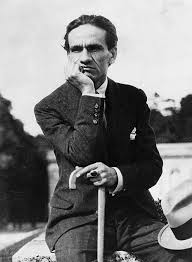
Beloved the one who sits down — Cesar Vallejo
Beloved be the unknown man and his wife.
My fellow man with sleeves, neck and eyes!
Beloved be the one who sleeps on his back.
The one who wears a torn shoe in the rain.
Beloved be the bald man without hat.
The one who catches a finger in the door.
Beloved be the one who sweats out of pain or out of shame.
The one who pays with what he does not have…
Beloved be the ones who sit down.
Beloved be the one who works by the day, by the month, by the hour.
Beloved be the one who sweats out of pain or out of shame.
The person who goes, at the order of his hands, to the movies.
The one who pays with what he does not have.
The one who sleeps on his back.
The one who no longer remembers his childhood.
Beloved be the one who sits down.
Beloved be the just man without thorns.
The bald man without hat.
The thief without roses.
The one who wears a watch and has seen God.
The one who has honor and does not die!
- ‘Songs from the second floor’, ‘You, the living‘, ‘a Pigeon sat on a branch reflecting on existence’ written and directed by Roy Andersson (2000, 2008, 2014.)
- ‘Watchmen‘ — Alan Moore / Illustrated by Dave Gibbs (DC Comics, 1986–1987)
- ‘Scenes from the big picture’ by Owen McCafferty (Nick Herne Books, 2003)
- ‘Beloved the one who sits down‘ by Cesar Vallejo (featured in ‘The Black Heralds’ anthology, edition by Copper Canyon Press, 2003.)


 stghostycreative.co.uk
Leave a comment