

“There’s no such thing as structure.”
That’s what this random guy said to me, unwavering eye contact, before proceeding to finish his vodka, be sick over the payment and drop their keys into the road.
Don’t worry, they were fine. He managed to do it with a certain amount of grace and I managed to get his keys back for him before awkwardly walking off to get some schawarma and head back to my flat.
But hear me out. I think he might have a point.
Structure is a word, an attribute. A comparison and a point of observation. It’s fill of bias. It’s tossed about as if we can fully comprehend the extent of its semantics, but of course we don’t, how could we? The extent of its application is staggering but so too are the implications of its enforcement and dissolution. Structures can be infinitely complex, holding great symbolic meaning or a kind of prophetic innanity. A logistics system, procedures, a novel, a highway, a family tree – structure determines the framework for deliverance.
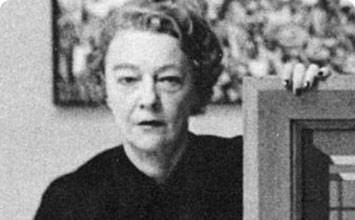
My point is – the keys-vomit guy might have been on to something. Something which helped me understand one of the most influential female surrealist in history, and one of our collectively favourite 20th century artists. Kay Sage.
Structure is deliberate but simultaneously self-perpetuating, in the sense that we accidentally create structures every day and aren’t even aware of the process. It is, of course, invaluable to view artistic structure as a principle that can only be tied down in a space relevant to its context – in as much as definition itself becomes a vacuous act.
We cannot be truly unstructured, and we cannot simultaneously define the world beyond our being as unstructured because we understand so little of it. Even hyper-chaos has elements of structural matter. Chaos is un-tampered and illogical, but only because we can’t comprehend it. The structure of perception is the process of an object being perceived, dragged into the light of our gaze and adorned with processes of observation, making a truly unstructured nature something that we could not possibly perceive, let alone represent, just the same as meaninglessness paradoxically implies the existence of meaning.
I haven’t slept in a while, so you’ll have to bear with my neuroticism.
Who is Kay Sage?
While dissolution of perceived structure is the bread and butter of a surrealist method, Sage has a special way of expressing this in a pragmatic sense. She is expansive, but very much to the point. I think it best, as ever, to take an incoherent method when viewing her work, and focus more on her later career and my personal favourites. I also won’t be taking a look at her poetry or sculpture work. I’ve added some links at the end for more complete discussions of her art that actually do justice to her style, should you be interested.
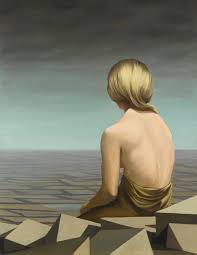
Kay Sage was creating sculptures, poems and artworks from her training in the 1920s in Italy up until just before her eventual taking of her own life in 1963, with her first majorly recorded work in 1938 with ‘a little later’ and ‘An important event’, the former of which can be seen below. Already you get a sense of her focus on structural points intersecting, a representation of definite objects in an uncomfortable, unusual order. The restructuring of structure.
Admittedly her work has far more outward reaching implications, other themes and details to be viewed and enjoyed, but her exploration of structure is one I find particularly compelling. It emerges most prominently in the later sections of career, producing some of my favourite pieces.
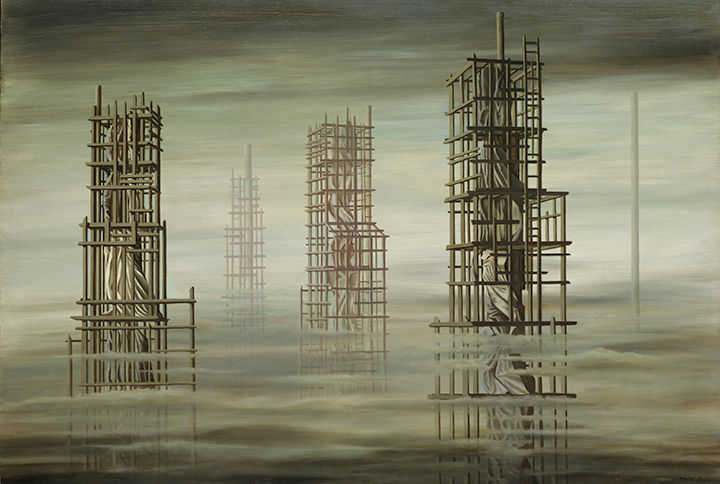
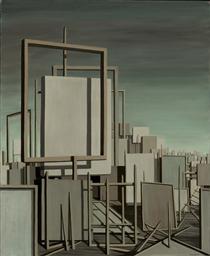
One of the most prominent paintings associated with Kay Sage is ‘Tomorrow is never’ (1955.) It was painted following a five month hiatus that Sage took from painting after the death of her husband, the French surrealist Yves Tanguy. It features a series of complex, densely built yet half-finished scaffolding towers protruding from thick grey mist below, up into a chasm of nothingness. It also features her classic sharp perspectives and focus on constructed artifice. There is no point where the mist begins or ends, it simply is.
It’s besting heart is derived from her use of architecture most commonly during this stage of her career, as a vehicle for isolation and the bleakness of humanity. I think one can view this more literally here as the scaffolding only just reveals glimpse of renaissance-esque marble statues, figures of humanity and humanity’s ideals trapped within qualified structure, trapped in designs of their own making in desolate, foreboding nothingness. Her grief is evident but it certainly not my place to try and impart personal significance here, while it’s undeniably a factor in her artwork that creates the long running themes of loneliness and isolation, it’s by no means the defining aspect of her work. It is only a potential nature, one I am gleaming from the human need to analyse.
Like I said, the unstructured must become structured, lest we become unable to perceive that which we cannot understand. Her exploration of emotional themes through specified, objective shapes becomes gradually more and more literal until you come to pieces such as this one, which create a more complex narrative as the structural representation themselves become more extensive. A series of concentric circles becomes architecture, and so acts to both mystify and develop pre-existing emotive themes.
Why Kay Sage?
I (and a few others I’ve met while gardening at an allotment) would argue Sage gives the definitive timeline on surrealist influence through design. Sage was arguably most prominently influenced by the art of Georgio de Chirico after seeing his work in 1937 in Paris, at the surrealist exhibit of the Galerie Beaux-arts. In 1910, Chirico was a co-creator of the Scuola Metafisica movement i.e. metaphysical painting, which was hugely influential to many of the original surrealists, and stands alongside Dada as one of its defining influences.
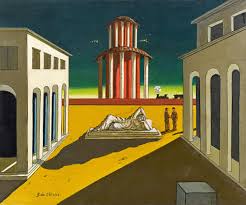
Chirico painted long roman arcades with sharp lines and colours dissolving in unusually poignant light, as if seeing a dream fade into a long dawn. Their art fleshed out the process of sharp features sinking into, or rising out of, blurred abstraction. Their paintings are often scattered with objects of symbolic resonance, and keep hold of a sense of profundity far distant from the viewer, often derived from a succession of Nietzsche’s philosophical principles outlined in artistic format. You can easily see it being a prominent source in Sage’s own use of architecture as a vehicle of exploration and expression, the metaphysical painters viewing architecture as a mode of definition, the literal tram lines over which the light of an artwork travels and is, in part, defined.
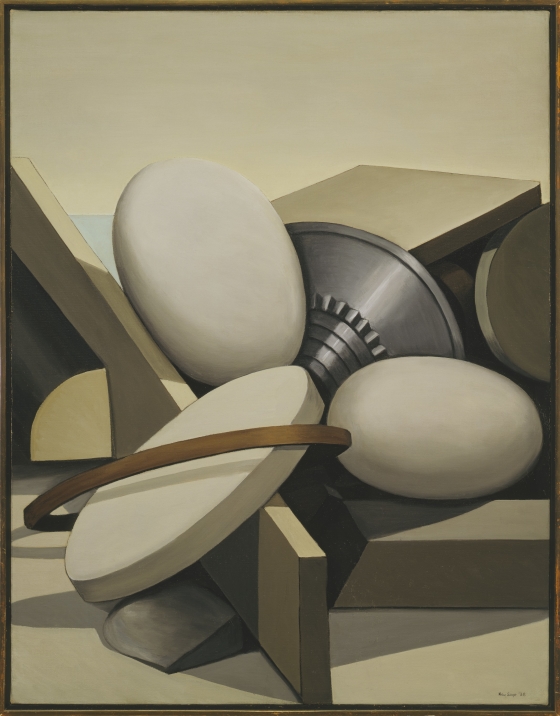
The prominent leap from exploring abstract shapes, to expressing the abstract through logical shapes can be observed through two more of my favourite works, ‘The answer is no’ and ‘Watching the clock’ (both 1958.) It would be fair to argue that these almost act as intermediary points between her transforming the previous, typically playful, shape motifs into more deliberate metaphorical and physical structures. The construction in these works feels far more deliberate, both showcasing an extensive series of shapes interlocking within square boundaries.
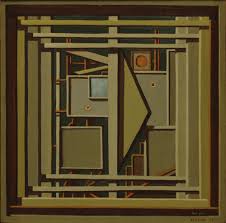
While you’re still witnessing the convergence of shapes into abstract matter, these works have a more direct air of creation about them. ‘The answer is no’ in particular leaves certain sections apart from the structure, and so the mass of empty picture frames and opaque squares comes across more like a desperately poignant attempt of a child in an adult’s body trying to build structure, trying to understand something but never getting anywhere, on a backdrop of yet another looming void of mist. ‘Watching the clock’ however seems more defined somehow. The shapes merge into a dark golden, bronze colour and evoke sensations of clockwork, mechanics and the concept of completion or totality. The light is warm, but the dark spaces in between the structure hint at concepts yet unseen, hidden from us by a need to design and build.
The Style Behind it:
The more I think about it, the more Sage’s work becomes desolate in its implications. It’s relatable nature is portrayed through its honesty, its bare-handed approach to underlining how little we truly comprehend in relation to our own being.
Unusually, three of her earlier pieces have a more formal approach to both the construction and deconstruction of architecture than those aforementioned, but I think prove an equally valid point. ‘Hyphen’ and ‘No Passing’ (both 1954) equally showcase the apotheosis of Sage’s conceptual design. In eventuality, her shapes finally become so complex that now they stand as buildings, with the landscape of ‘No Passing’ virtually existing as an abstract city-scape, contrasted and undermined by its own simplicity and blankness, its own reliance on colour for substance.
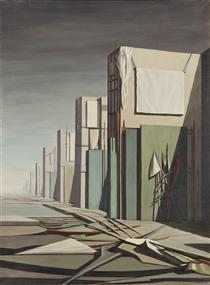
Likewise, ‘Hyphen’ uses her regular motif of square shapes layered over and over until it stands as a monolith in a great, dark desert, protruding from nothingness. The structure reaches from two intersecting points of the canvas, the shadowy blue sky and the unseen origin, the off-view point where the structure emerges from, it extends between meaninglessness and meaning, from the structured to the unstructured. It seems especially apparent then that its reach for meaning ends without conclusion or beginning, the building simply extends as far as it can into the deep sky, trying as hard as we can to comprehend that which we do not.
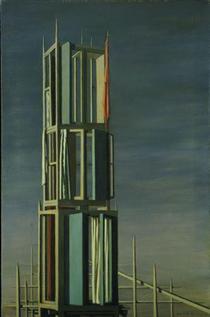
The building itself dissolves into a secondary function, beyond its lateral construction and instead into the metaphysical, symbolic significance as a motif for the act of trying to understand, the act of creating the work of art itself through abstract structure, a desperate attempt to understand.
Sage’s work has this void that appears out of nowhere when viewing her work, a foreboding atmosphere, much like in those previous pieces. There’s always a sudden materialising desolation that appears out of what was previously an artistic experiment of construction. ‘The Unicorns Came Down to The Sea’ (1948) represents this in a physical sense through the most simple of terms. The image is another construction of flat, square shapes that appear like the walls of a villa but instead have collapsed with dregs of cloth draped over them that look much like seaweed on debris, providing careful additions to the mute colour scheme.
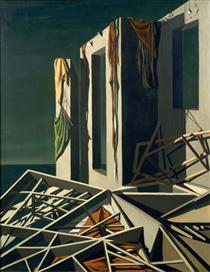
to The Sea‘ – 1948
Her Legacy:
Sage offers up a paradox to any contemporary artist, where a viewer is presented with representations of structured and unstructured principles, an so initially the picture seems simply enough. One views it with a certain poignancy and that familiar glint of mortal fear that appears whenever we see the ruins of human enterprise. But then again, the debris that appeared so simply to be debris is fallen in such a way that it resembles those earlier concentric patterns of abstract shapes.
In a sense, the image embodies the living dichotomy between Sage’s previous and newer works, between two emotional drives. The motif divides itself to embody a desire for understanding, as well as a realisation that such a thing is impossible. In its simplest components, it reduces hope into basic functions so that the emotion exists only in a potential sense, the ingredients for the process of gaining and losing hope, the hope of hope as it were. It’s an image that tells a story through dark shades and smooth contrasts, that of a person trying to comprehend their existence in the world itself, while painfully aware that they will never amount to any such understanding.
Kay Sage was not only one of the most influential artists of the ‘Golden’ era of surrealism, but also an artist whose use of architectural structure within abstract formats defines the most poignant of emotional frameworks. She embodies the need to understand that which we do not, and her work enables a kind of meta-commentary that reminds us of how fragile and yet how incredibly complex the concept of structure is in our lives. Her art is as philosophical as it is surreal, and acts as an invaluable bridge between the sharp contrasts of metaphysical painters and the layered detailing of later neo-surrealists between the early and later parts of the 20th century.
She bridges gaps in all sense, always between two intersecting points of comprehension, and always ending up somewhere within a yawning of the unknown. Her artwork is desolate and unforgiving, structural in subtle methods and near post-apocalyptic in their scope, the still scenes echoing the utterance that hope once existed.
Hope is the most tragic of emotions, and I think Kay Sage understood this more than most.
Got an opinion you want us to share?
Then email us at stghostycreatives@gmail.com, or contact us on our socials, to contribute to our page. We’d love to meet you!


 stghostycreative.co.uk
Leave a comment