
A subjective interpretation of ‘reality’ is essential for a surrealist perspective. A definition of ‘illogical’ must be coupled with the presupposition of the existence of something ‘logical’. To find absurdity in the everyday is key to its construction, much in the same way as we pick apart information in the most bizarre of our dreams. The differentiation between all of our individual realities then, only leads to a breath-taking degree of possibilities for defining artistic value, and the space in which we define it phases into fluid, lateral structures. This of course this could be applied simply to all artistic endeavour, indeed, all metaphysical inquisition in itself. I realise I’m being laboriously general with this but bear with me.
By this logic then, different variations of surrealism stem from different lived experiences, as with all expressions of thought, and so a factor that fundamentally changes your experience in our socio-cultural spheres would undoubtedly shift your understanding of expression as well as the content of it, adjusting the way in which you utilised a framework that was surreal, or resembles what we know as the surreal, to create a narrative yet unseen. Therefore the ‘unseen’ creation is comprised of both known reality, and of unknown factors converging into a relative mysticism.
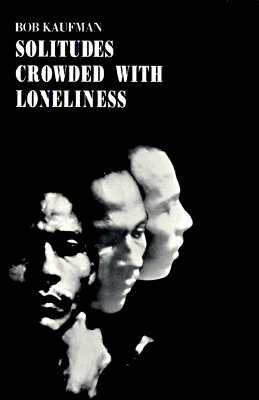
There aren’t many narratives which envision this relationship as well as the Afro-surreal movement. It’s a retrospective term coined by Amiri Baraka when writing on the influence of Henry Dumas’ work in 1974. An aesthetic, artistic framework which creates new mythologies and identities through abstract form for individuals throughout the black diaspora, aiming to represent the absurdity of the everyday experience of being black, subverting the pre-existent, pre-dominant, white-European narratives in favour of new, more diverse identity stories, far apart from previously restrictive narratives. My latest foray into surrealist poetry was with ‘Solitudes Crowded With Loneliness’ – the 1965 anthology by legendary beat poet Bob Kaufman. The sheer merit of his work is by the by at the moment. What’s really struck me after reading it is the sheer breadth of his style, it’s a style that smoothly grips you along the exact kind of narrative afro-surrealism is so successful in conveying, that of a simultaneous existence between place, identity and the processing of the two through abstract imagery. It’s something I’ve been thinking about a lot recently, and to be honest he’s fast becoming one of my favourite poets.
I’m not skilled enough to properly review things generally and have too little intertextual knowledge to be able to articulate the real hinges of Kaufman’s work and career, let alone the wider implications of afro-surrealism development. I guess in a way that’s a bad excuse but my ineptitude leads me to the question of one’s own observations of the eternally subjective. The best I can do to surmise my experience with Bob Kaufman is to take a closer look at the relationship between stories of everyday experience, as fundamental factors for surrealist narrative.
The definition of surrealism as a movement of course originates from Paris, but the expression of its meaning and the practise of its form has been explored since the ancient world in countless cultures. The mode of abstract expression is undoubtedly universal. A perfect example of its development through the 20th century is the beat movement of America. Poets and authors like Kerouac, Ginsberg and Callaghan all utilised abstract elements in their works to portray a savage picture of what they saw as contemporary America. Kaufman was no different, born in New Orleans but occupying San Francisco for much of his adult life after meeting Jack Kerouac and setting up the ‘Beatitude’ magazine in the city alongside Ginsberg and John Kelly in a coffee house in 1959.
However, an additional language underpins Kaufman’s work, a series of signifiers relating to his own experience of race. The everyday of his reality had, in itself, an absurdist logic, partly because it was defined by the fact that the predominant power of his society saw the darker tone of his skin as a signifier for countless, malicious potentials. Simultaneously, his existence within American society, as a part of the black diaspora, results in an expression throughout his poetry of fundamental difference, even if that difference is not expressed in overtly racist, or violent tendencies directed towards him. The beat movement was a home for marginal figures of society, and the jazz poetry of Kaufman was a better fit in that definition than any other.
There is an immediacy to the Afro-surrealist movement, it aims to emulate the details of black lives at this perceived moment, and reflect new mythologies for the purpose of re-establishing a historical narrative. Likewise, this immediacy can be felt throughout Kaufman’s work, expressing its images through jazz stylistics and a linguistic matter than is malleable, constantly reforming. It is an aesthetic crafted to resound through the annals of oppressive historic faculty, and utilise a certain neo-sorcery, magically-realist function to re-order a history that is already so chaotically misinformed, whose teleology is already geared so heavily against any kind of identity that could be defined as ‘black’. It aims to manifest a world that, in actuality, already exists. The act of Afro-surrealism is to pull that world into view, out of the yawning whiteness that previously eclipsed it. Kaufman continues this tradition in his upheaval of everyday experience into the higher realm of ultra-real, a realism so complex that it becomes naturally abstract. This climaxes to the point of the ‘Abomunist Manifesto’ included as a series of necessary factors in the form of a truly beat-style poem towards the end of the anthology, appearing distinctly playful compared to the rest of the collection but embodying the same principles nonetheless.
‘Solitudes’ also includes his ‘Jail poems’, originally published in ‘Beatitude’ in 1960, detailing his incarceration over a series of stanzas marked by roman numerals, each varying in length but typically up to 15 lines, each varying in how they strike you through the page, the longer segments laying layers upon layers of thick, surreal images and the one liners flooring you with un-tempered poignancy. This section in particular reflected his poetic relationship with a sense of place. The poet is literally trapped inside an institutional space, the symbol of oppressive, Euclidean, social logic. In here he, and all those around him, are bore upon by the weight of the supposedly logical. Continually, his only response to such abhorrent construction can only be to reflect the absurdity of it. The reality of his surroundings is already surreal enough, his poetic symbols reflects it into a different abstract state, aside from its pre-existing, nonsensical significance. It’s not really relevant but I can’t help but include one of my favourite phrases out of personal indulgences, which clearly demonstrates his direction towards magically realist expression, the non-linear imposing itself on our faculties through near-mythic imagery.
“The jail, a huge hollow metal cube, hanging from the moon on a silver chain.”
D.Scott Miller’s famous 2009 ‘Afro-surrealist Manifesto’ explains it in far greater specifics and with more extensive breadth, He outlines its liberating nature, and delineates it from surrealism itself through its focus on a mysticism and ambiguity specific to the black diaspora, it acts as an invaluable starting block for anyone looking to explore it further –
I think the section from Miller’s text that best describes Kaufman’s underlying narrative is here –
“Afro-Surrealism rejects the quiet servitude that characterises existing roles for African Americans, Asian Americans, Latinos, women and queer folk. Only through the mixing, melding, and cross-conversion of these supposed classifications can there be hope for liberation.”
Kaufman’s poetry is varied is both form and subject. His focus swings from political analysis, through beat style, romantic verse and dedications to figures such as Hart Crane, Ray Charles and Albert Camus. His work sinks into a significance that extends its own space the more it is observed, each theme swelling outwards until it becomes an expression perceiving so vast a subject, that it comes close to cancelling itself out. Each poems zooms out gradually, after providing tangible proximity to its poetic heart. He appropriates symbols of America’s past like all beat poets, and uses it, not to distort his reality, but to reflect it tenfold, through countless lenses that reflect its intricacy and beauty until it spirals out of control. Experiencing his work is more like glimpsing a bullet in slow motion for mere seconds, observing the colours of the light reflecting to such an extent that one can see all its components simultaneously and all those who have ever touched its metallic surface, before time resumes and it flies past out of view, leaving only an impression.
Afro-surrealism is fluid. It exists to establish neo-narratives, but simultaneously reflect pre-existing power. ‘Solitudes’ embodies this wholly, while moving at such great speeds that it’s true nature is virtually imperceptible throughout the text. Even re-reading his poetry feels like a different experience, a submergence into a memory that changes definition like trying to view shards of a mirror in endless strands of phosphorescent light. Kaufman reflects a quiet loneliness and a fury so loud that it cancels itself out, it is expressed not through screaming howls but through the manic submission of image after image that weighs down the text before catapulting it into the atmosphere. His poignancy is undeniable, it pervades every aspect of his work, but trying to tie it down to specifics is like trying to think of the most ‘important’ day of your life. You have plenty of options to choose from but you just can’t pin it down because there’s no definite aesthetic for it, and choosing one becomes an arbitrary act.
Kaufman is one of the few poets who writes like he wants you to forget you ever read his hushed words. The poems are spectral clouds that refract the light around them, internalising and spitting it out into absurdist shapes that stop you dead in your tracks, as they conjure images of power, mythos and a yawning breath of experience that is both seen and unseen in all parts of our contemporary culture.
Further reading that I’ve enjoyed on the topic if you’re interested –


 stghostycreative.co.uk
Leave a comment