At worst, horror in television discolours the entire genre and gets thrown onto the pile of would-be terror inducers from the mid-late 2000s Hollywood scare machine. But at best, it does what ‘Channel Zero’ (SyFy channel, Nick Antosca) does – it helps redefine what’s possible in the format, and re-affirm what horror fans already know to be possible. Be aware that, while I won’t be giving a complete synopsis for the series, there are some pretty major spoilers ahead and I would definitely recommend you watching before reading if you can.
It’s received huge amounts of critical appraise, scoring a 93% on Rotten Tomatoes and a solid 7.2 on imdb. Described as “creepy, unsettling and refreshingly unique” (The Review Geek, Greg Wheeler, 2018) and “the most legitimately terrifying series on TV” (Thrill list, Aaron Pruner, 2018), this show fascinated me as soon as it brushed across my radar.
Though therein lies another point, that it took so long to come anywhere close to my radar. I believe the most apt quote I saw on the programme was describing it as “The scariest horror show you’re not watching” (Vulture, Shaun T. Collins, 2018.) It’s success has been a quiet one, as the show’s creator Greg Antosca often attests to, however it’s undoubtedly growing, despite the fact that show has now unfortunately been cancelled.
Channel Zero is an anthology horror series with four seasons, each providing six episodes of a self contained story. They follow the emotional turmoil of a series of characters, who encounter something that completely redefines their world, and usually forces them to face their innermost fears and complexes i.e. It’s a pretty standard format in theory, its anthology status being one of the few factors that initially makes it stand out. It’s only the stylistics that come across immediately the trailers that start to make the show seem more distinct in its abstract approach to storytelling. If it wasn’t already right up my alley, it takes an often surreal approach to its horror, moving away from several traditional cliches that were born from the aforementioned mediocre horrors of the 2000s. Then I watched the opening scene of Candle Cove (season 1) and I can safely say that it’s one of my favourite scenes of all time.
It begins with Mike Painter, the central character of this season, in an interview. He’s discussing his new book he’s released as a child psychiatrist on the complexes and psychological reactions to trauma. As the interview progresses, everything begins to feel very, very wrong. The interviewer suddenly asks deeply personal questions. We learn that Mike was involved in the Iron Hill murders when he was a child back in the 80s, and that his brother was murdered as a result of this unresolved crime. Out of nowhere, the interviewer produces a phone and requests Mike to council a child who is live on air and has recently gone through a similar trauma. The situation borders on the absurd in its emergence into dream logic; it’s uncanny. We’re presented with a very familiar setting in a scene that makes us feel safe, and yet we become acutely aware that not everything is right. This is one of many techniques the show uses throughout it’s seasons to give a distinct dreamlike quality to its horror, rather than relying on more traditional catalysts for tension.
As Mike begins to speak to the child, they start laughing, quietly and menacingly. It gets to him, especially when the voices suddenly utters “Mike, why are you afraid to come home?” – he hangs up the phone, unable to take anymore. As he does so, he stares at a dead fly in his water. It doesn’t sound like much but the focus on these symbolic motifs focuses your attention, until you realise that the TV studio has gone silent and, even as a viewer, you suddenly feel inexplicably vulnerable. Mike looks up to see the host of the show staring at him blankly – it sounds insignificant but his expression is what terrified me the most.
It’s like when you see a baby staring at an adult whose face isn’t moving, they’re desperate to try and read emotion to determine the situation but they can’t find it, and become isolated. Mike turns to see that the crew of the show are actually mannequins, and the scene unfolds in nightmarish fashion, when it it feels like all sense has left the world. The phone rings again, and the camera focuses on Mike’s face as the host suddenly comes to life to ask (in the most conversational tone imaginable) “Mike, why are you scared to come home?” Without warning, we immediately cut to a person covered in hay and long robes of fire, shuffling down the corridor as the flames roar to what feels like an inescapable conclusion.
It’s a scene that inspired me so fundamentally. it has all the surreal, dreamlike qualities that undermine people’s expectations of what horror ‘should’ be. It begins the slow burning characterisation of Mike, as well as the relationship with his younger twin brother. In other scenes this feed of information might feel forced, but the acting style of Paul Schneider (Mike) constantly downplays the emotional significance of what’s happening, which is all the more rewarding when you see it lessen in later episodes. The scene achieves all of this while letting you know very succinctly that you are not safe. You are never safe with this show. At any point the disturbing, the uncanny and the dreamlike could come reaching out and try to grab you. But there is one thing in particular that’s key for me – that this doesn’t happen all the time, but feels like it could happen any time.
In retrospect, the firsts series is undoubtedly my favourite, with the others come closely behind due to present but mostly forgivable criticisms. To be honest I could write for a very long time about the whole variety of examples such as the above, but won’t as I haven’t the space and far more people out there have written better summaries than this. Instead I want to look at particular moments that really captured me, and solidified my morbid fascination with this series.
Candle Cove is certainly a good place to start for this, given the constant stream of strange happenings in a familiar small town setting of Iron Hill. The series follows Mike as he returns to the town of his childhood, following the terrifying dreams he’s been having (i.e. the above scene.) As mentioned, I won’t go into too much detail in regards to the plot, through the next six episodes, you witness Mike attempt to solve the Iron Hill murders, while at odds with the local residents, many of who he grew up with. He begins to realise that a TV show named ‘Candle Cove’, which can only be seen by children, has been brainwashing children into committing depraved and disturbing acts, all in order to get close to the titular beast of the series, which I will most definitely be coming on to later.
One of my favourite aspects of the first season is that the horror is surrounded by what is essentially a murder story. Much of the drama focuses on the different motivations of the towns residents, all propped up with solid yet succinct dialogue. We also receive flashbacks to the 80s when the original events occurred, and as a result every action of the series always feels like it has a clear and definitive reason for happening. You could even say that it benefits me having watched the series again, with the ending plot points in mind. It blends this naturalism perfectly with the abstract sequences, as the gradual, psychological disintegration of the town is laid out in gradual, unexpected stages.
A favourite dynamic, while being a (MASSIVE SPOILER), is the relationship between Mike and his brother, who is played as a child due to him being murdered back in the 80s. Mike’s brother is at the centre of Candle Cove, and exists in this ‘beyond place’, himself possessing extraordinary powers over the townsfolk in an effort to get revenge on Mike. There are several incarnations of his power. One nice connection is a scene when Mike runs down a hospital corridor to see one ward which has a curtain made of flesh. Later in his brother’s other world, these same curtains line the space, giving a very Silent Hill vibe to the situation. Equally there are multiple large, doll creatures that appear from the TV show who follow and taunt Mike at several intervening sections. Furthermore, the ‘Skin Taker’ is a robed human who judders and shuffles to and from, poking holes in his clay face – which was very reminiscent of Olivier De Sagazan’s sculpture work, and had a noticeable Butoh feel about his physical performance.
Though the best example, and the most prominent one you’ll find if you put the series into Google images, is the man made of teeth.
He is quite literally a man made entirely of teeth. He approaches Mike as several points and rams his hand in Mike’s mouth to pull some more out for him. One of the townsfolk who worships Mike brother as a supernatural entity even leaves children’s teeth out for him to feed on. I don’t recall any point where such a horrifying creature design was used for a cheap scare, there was no “I think the coast is clear, lets slowly open this door just to double check” moment. All his movements are slow, he never leaps out of hidden corners, he always emerges slowly. You get to savour the unique costume design through simple, clear camera angles. The horror is focused on the movement of the creature, and the terror you feel watching him approach a defenceless child in a hospital bed. With all these creatures, their appearance startles you, but I never found myself jumping or reeling back. The horror is in the uncanny, that which is familiar but oozes potent malevolence and lasts for far longer afterwards.
This continues in the second series of 2017, No-end House, where a group of friends become trapped in a Stepford Wives-esque, simulated paradise which promises to bring back those loved ones that you’ve lost at the cost of wiping all your memories away. The show explains the presence of the house as a phenomenon that America’s youth see as a rare art installation, and so they flock to see it. The house has six rooms one must got through, each reflecting your deepest personal fears. The rooms all have wonderfully surreal representations of these terrors, not all of which the show allows you to see in a continued dedication to subtlety .
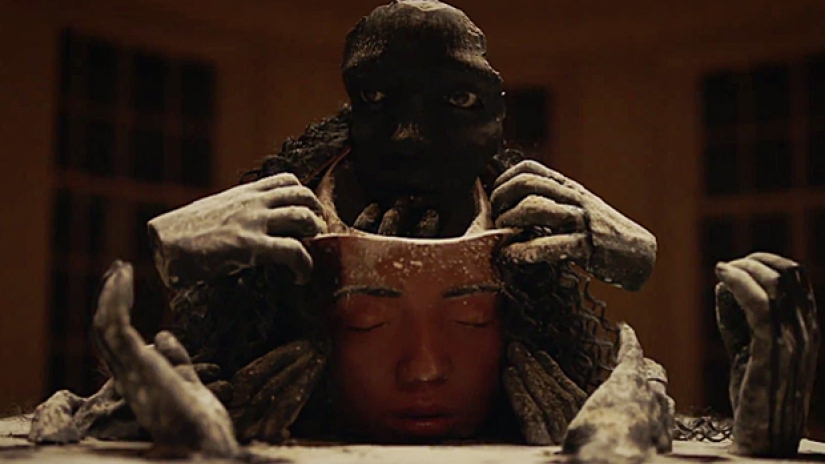
The title image for this post is a perfect example, a sculpture found in the room depicting one the two main protagonists (Jules – played by Aisha Dee) having a sinister face crawl out of her skull. Another room is blank, industrial, until all the lights go out. When they come back on, a man in a black suit with a wooden mask walks through staring at them all, taking a look at each character one by one before the door for the next room opens.
The beauty of the house is that it provides a setting which requires no specific explanation, and yet it allows one to insert exposition without forcing it down people’s throats. It’s by no means a complete surrealist epic, much of the character development occurs through naturalist dialogue and intense conversation between Margot (our central protagonist) and either her father or Jules. These are the most deeply explored relationships, with the later antagonist, Seth, playing a major role but never really receiving the same focus.
Conversely the house, and the alternate world, provide a landscape to tell a story through symbols. The alternate version of Margot’s dead father appearing and devouring physical manifestation of Margot’s memories in order to survive is a particularly memorable motif that’s repeated by several other of the entities within the house’s world – otherwise referred to as ‘Cannibals.’ Even aside from the main story, it uses certain techniques a handful of times to tell a wider tale about the world they’re in, and power an internally facing, self-analytical narrative arc.
One of my favourite examples of this is a man Margot’s cannibal father finds watering his plants. As Margot’s dad frantically searches for her, the man simply stands there calmly and talks about the weather, absent, otherworldly and disturbingly devoid of humanity. Equally, when Margot escapes into an abandoned school, she is grabbed by a strange old woman who hushes her in one, long, continuous noise. Again, this is simplistic but effective; it offers no explanation aside from reflecting the panic of Margot’s own journey. Granted, not all the examples work – namely a giggling man who stalks Margot and Jules at certain points and the alternate version of J.T (another member of the group) whose purpose is to reflect a better, more confident version of him. I believe the idea of this is to tell some kind of familiar ‘teenage dirtbag’ type story that’s neither interesting nor engaging in any way for me.
‘Butchers Block’, the third series in 2018, resents a similar relationship between people and place, or rather people as composites of a dreamscape. Without dragging up too much of the story itself, the two central characters find themselves in an alternate world. It’s a wide open corn field under the shadow of large, plantation-style house stalked by bizarre yet memorable creatures of a distinctly unsettling design – specifically the representation of a characters fear of inheriting Schizophrenia from her mother as a tall, lanky man wearing pyjamas and a papier-mâché head with a blank, expressionless face . Once again we see an alternate environment used to subvert any expectation of what could happen ‘next’ as it were. It’s a core mechanic of the programme that keeps it often unpredictable, and intriguing. Rather than resorting to the monsters, the places and the people you think the narrative would rely on, it often surprises you with something completely different. Likewise, it allows the story to be told through through the juxtaposition of images as much as anything else.
While I have my reservations about the 3rd and 4th season (‘Dream Door’, 2018) I found all of Channel Zero an enjoyable thing to experience. The focus on symbolism and the use of subtle, unpredictable motifs, works to solidify every last image deeply into your mind. The further you delve into each series, the more you begin to become addicted to the freedom that such a narrative provides, allowing one to enjoy the confusion or surprise of different scenes, as much as the drawn out themes of each series. As Rene Magritte argued,
“What counts is precisely this moment of panic, and not it’s explanation.”
That moment of panic is what Channel Zero relies on to create tension and drive in it’s horror. The explanation is always there in (often) well crafted dialogue, but the initial surrealism of its images and motifs is always the tool the drives the message home. It consistently and effectively reflects the emotional stories of its characters in a way that feels original and, in many parts, wholly unique. I can’t recommend enough watching this series, especially ‘Candle Cove’, as this show is now well set as one of my favourite horror anthologies that I’ve seen in the past decade. We can hope that a more diverse focus on what was once considered too ‘weird’ to be on television continues in the shadow of this series, or at least a reinvigorated evaluation of how well horror can work in this format beyond more cliched or uninteresting examples of recent years.


 stghostycreative.co.uk
Leave a comment