
I probably talk more about wanting to write about ‘Silent Hill‘ (Team Silent, Konami, 1999) than I do about anything. But that’s only because it’s so fundamentally unsettling through its surreal exposition, and such a perfect example of contemporary art in the movement. Now that opens a whole new can of worms about me defining video games as art – but if there’s anything that supports me it’s the work for Silent Hill. It’s lead designer, Masahiro Ito, worked on the first three games and was given a special mention in the fourth, as well as creating an interactive manga ‘Silent Hill: Cage of Cradle’ with Hiroyuki Owaka (original script writer of Team Silent.) But his concept design for the creatures and the world of the game is inspiring in how disturbing it is, each creative part of a monster representing a psychological demon of another character – every disturbance is merely a reflection. A lot of Silent Hill takes surrealist momentum to heart, and it’s for that reason I want to share four of my favourite design elements of his.
1.) ‘Closer’

Appearing in ‘Silent Hill 3’ is the horrifically visceral ‘closer’ monster. In context – the game’s protagonist, Heather Mason, is in the middle of a vision in a shopping mall which drives her to visit Silent Hill. In it she explores the monochrome corridors of the oppressive building only to find this creature consuming another human. She meets them throughout the game and their appearances are terrifying. They are tall, lumbering, with two huge stumps for arms which look as though they’re carrying bags via their biceps. The head too, is formed from what can only be described as a twitching, elongated labia-type thing. That’s honestly the best description I can muster. As with many creatures in the game, the appearance isn’t so much classically scary but imposingly weird, resulting in a player having no idea what to make of this thing. The movements of it too are memorable for the twitching, the sharp juddering that males it so hard to predict, as if it’s only just made its way into reality from someone else’s nightmares. This twitching is often a notable design of the series, it appearing again when the original director, Hideo Kojima, created ‘PT’. Team Silent stated that one of the many influences for the series was the 1990 horror film directed by Adrian Lyne, ‘Jacob’s Ladder’ – which also contains the same twitching and inhuman movement in it’s creatures, blurring reality and creating what is often referred to as ‘thalidomide’ horror i.e. creatures that appear as malformed versions of reality, parodying something by taking a metaphorical contortion into a physical one. According to the guide to the series, ‘Book of Lost Memories’, the closer is so named for its ability to block pathways with its huge, unsightly form. There is much speculation as to it’s symbolism but I often like the idea put forward by fans that it represents a twisted version of the malls shoppers and consumerist culture. The arms resemble shopping bags and the mouth obviously resembles a vagina – perhaps suggesting a carnal, consumptive nature to the creature that parodies our own culture of consuming as much as we possibly can. Another interesting idea is that these creatures were born from the hate of a child (Alessa, one of the game’s antagonists who creates the ‘darkness’ of Silent Hill as revenge against the town’s inhabitants) and so their design appears childlike, fearful in a primal sense in the same way you can scare an animal by simply appearing as large as possible.
2.) Eileen’s Head
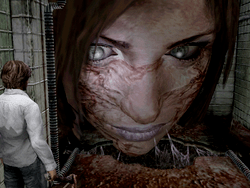
This is probably a weird entry, and rather than the specific design of a creature, it’s more the integration of a specifically weird sequence in the fourth game, ‘Silent Hill: The Room’. It’s a section where the player enters a distorted version of their apartment block, covered in fog. They enter a room which is blocked by an enormous female head, that of another character Eileen Galvin. Her eyes follow the player around the room and twitch manically as they do so, yet this head won’t actually do anything apart from stare and moan. This is just such a surprisingly bizarre encounter that the first emotion you feel is fear. The head can’t hurt you but you resent being followed by it’s frantic eyes, and the room feels so much more oppressive because of it – all you want to do is leave. It’s argued that this represents many things, as Eileen is hunted by the antagonists Walter Sullivan as a sacrifice for his religious delusion, so it could possibly represent Sullivan’s hatred for the fact she escaped him – much like how something that bothers you can act as an dominating force in your mind – so to does Sullivan have Eileen’s head bulging in his. Another interpretation that I quite like is that throughout the game, which revolves around the player locked in their apartment by an unknown force with no way out, you can spy on Eileen next door through a peep hole. Whether this is to check she’s okay or an attempt to call for help, it’s an invasion of privacy and an act that drags the player into a moral grey area. This scene seems to have turned the tables, with Eileen’s gaze fixated on you, spying on you as you feel most vulnerable playing the game. It’s a perfectly random moment that ends up scaring you for reasons you do;t really understand.
3.) Twin Victims
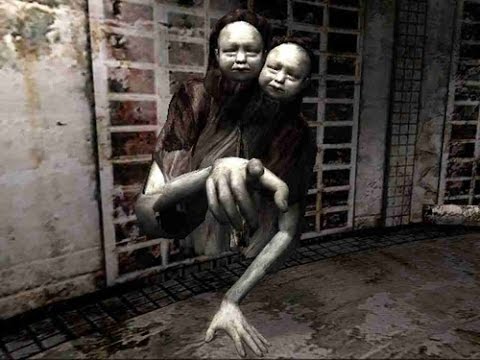
The Twin Victims also appear in the fourth instalment of Silent Hill, as the re-imagined, distorted versions of Billy and Miriam Locane. These two children were murdered by Walter Sullivan in his attempts to rebirth a god by killing enough ‘sacraments’. Most of his victims return as spectres, but these two return as a twisted creature, symbolic of the taking of innocent life and their lost years. Their physical form, a twin faced, hunched monster walking on long arms shows the physical attachment of the twins but also a metaphorical one in death. It’s interesting that these creatures won’t attack a player unless they get too close or provoke them, often pointing at you and whispering “receiver of…”. The role of parenting is a common theme in the game, as you run into the child form of Sullivan many times – so this could also represent the concept of children without parents, wandering aimlessly and forming an unnatural attachment together. My personal inclination though is that it highlights the anxiety of attachment issues, a physical manifestation of the dangers of attachment issues – as often they stem from a fundamental issue in the relationship (this one being that they’ve been taken away from their parents. Either way, they’re terrifyingly surreal, especially in that moment of panic when they point at you with long white hands and whisper – it’s a strange encounter that makes you thoroughly nervous every time you come across one of them.
4.) Pyramid Head (aka. Red Pyramid.)
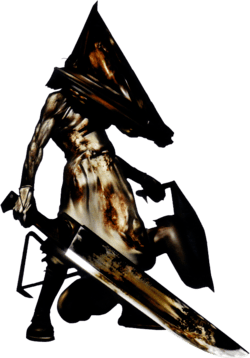
I couldn’t really not mention Pyramid Head in a list about Silent Hill. He’s the most iconic figure of the series, and brings with him a sense of distinct, and surreal dread. This antagonist appears in a fair few instalments of the series, but originated in the second one – where he hunts down the player protagonist James Sunderland.
Just to say, major spoilers ahead.
So Sunderland killed his wife Mary, which is arguably why he received a letter from a reincarnation of her telling him to come to Silent Hill. He’s somehow repressed this memory though, and throughout the game James will run into Mary, only for her to be killed multiple times and multiple ways by Pyramid Head. So it’s generally well accepted that this guy symbolises James’ desire to be punished for killing his terminally ill wife, and the guilt that follows that emotional drive. If everyone has a demon waiting for them in Silent Hill, then this is James’. It’s the psychological aftermath of intense trauma and so hunts James throughout the town to fulfil his own sub-conscious wishes. Pyramid Head’s design conveys that pain and the weight of grief in physical forms, having not only the metal pyramid as a head but also wielding a great-knife far too large to use (even though he does make several rather gruesome uses out of it.) Ito, when interviewed, stated that he wanted a monster who’s face was obscured, but his drawings all came out looking like humans wearing masks. However when he hit on the idea of a triangle, he claimed the edges reminded him of “pain” and that the weight of it as metal accurately reflected James’ own emotional weight. I find Pyramid Head so distinctive and all because off an odd design choice – he’s lumbering, slow, moaning but he’s also fairly well built and so you get this weird combination of human and inhuman elements. Much how Freud claimed our fear of the ‘uncanny’ is based on not being able to tell if something is human or not, our fear of Pyramid Head lies in how much a part of our protagonist he is and yet how simultaneously alien he is. Indeed, he only exists because of James’ guilt.
These are my personal highlights of Ito’s design mainly because they all share one thing in common. They all expose psychological demons through symbolism, a physical manifestation of metaphorical emotion. In Silent Hill, the symbolic becomes reality, and so the surrealist influence on the design of its set-pieces and characters is unmistakable. For me, It’s a series that was a perfect addition to the contemporary wave of surrealism in popular culture, and undoubtedly one of my favourite horrors of all time.


 stghostycreative.co.uk
December 16, 2016 at 12:30 pm
This was such a good idea for a post, and a really great list! I saw Pyramid Head coming in at #1, but I don’t blame ya for it. He’s such a great choice
LikeLiked by 1 person
December 18, 2016 at 11:54 pm
Thank you! Yeah I felt like I couldn’t leave him out, he’s just so iconic
LikeLiked by 1 person